I gave AI the keys to my business. It only worked because of what I built first.
Jul 21, 2026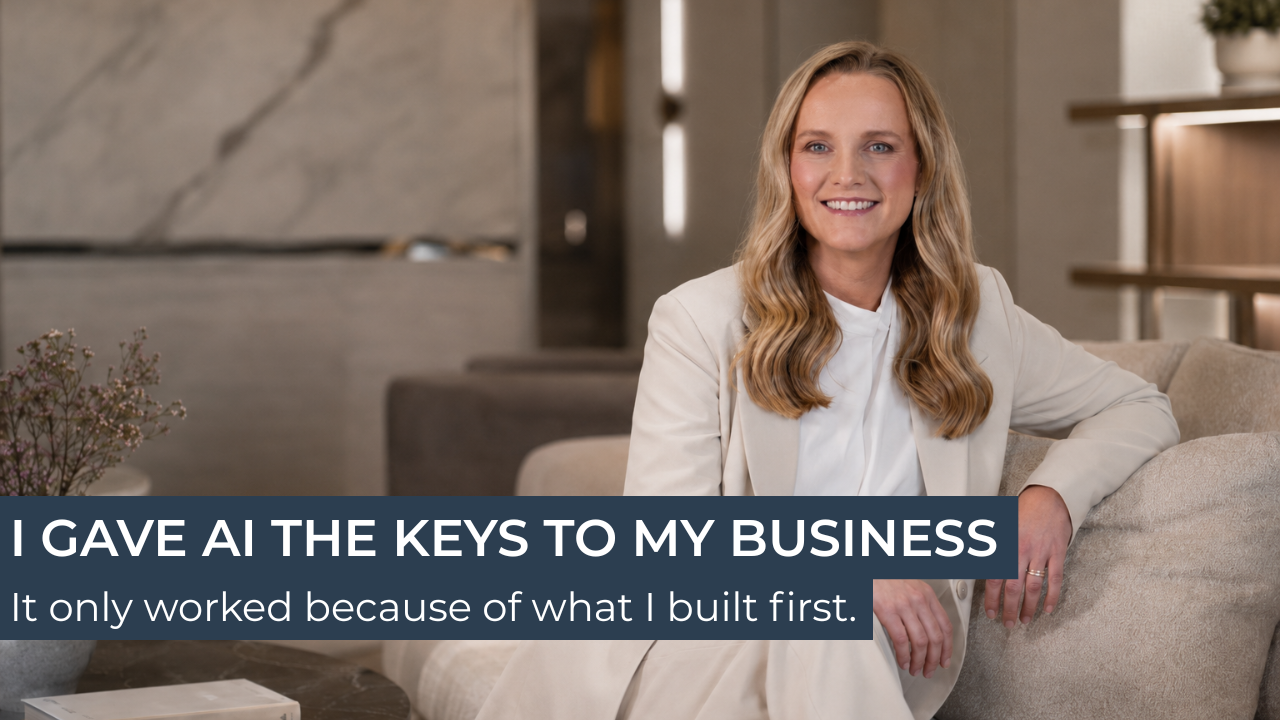
A few weeks ago, I gave AI the keys to my business.
I mean that literally. It makes edits directly inside my website, drafts the emails that arrive in my subscribers’ inboxes, and manages the content plan that decides what I post across every platform. And recently it took my entire Strategy by Design course and re-arranged it into something easier to follow, which is the version I will be relaunching in September.
I know how that sounds. Depending on where you sit with AI right now, it either sounds thrilling or it makes you want to close this article.
Neither reaction is the one I am after, because the tools are the least interesting part of this story. None of it worked until I had built something far less glamorous first.
You have seen the lists. The eleven AI tools you apparently need right now, or the workflow that writes a month of content in an hour. Every week, a new one arrives with the same promise attached: this is the thing that finally saves you time.
And if you have actually tried them, you know what tends to happen. You type in a request, and the answer arrives in seconds, and it is fine. Usable, even. It also sounds nothing like you, so you edit it until it does, which takes almost as long as writing the thing yourself, and somewhere in all that editing, you decide AI is overhyped and go back to doing everything by hand.
If you have spent years building a real body of work, a book with your name on it or a method you have refined across hundreds of clients, that moment stings twice as much. The last thing you need is a machine that makes you sound like everyone who has not done the work.
I watch smart, accomplished women reach that conclusion every week, and I understand why. I also think it is wrong, in a specific way that nobody selling the tool lists will tell you about.
AI is the most capable stranger you will ever meet
In my AI by Design workshop, the first thing we build has nothing to do with tools. We build three files. One holds who you are, meaning your story, your method and what you believe about your work. The second holds who you serve, and I mean the actual person, not a demographic. The third holds how you write, right down to the words you would never use.
People are sometimes disappointed by this. They came for the magic and I hand them homework about themselves. But this is how we create magic later on.
Think of it this way: AI is the most capable stranger you will ever meet. It has read more than any human alive, and it knows nothing about you, so when you ask it to write your newsletter, you get a stranger’s newsletter. The machine was never the problem. Nobody made the introduction.
So before a single connector was switched on in my business, Claude already knew my story, my frameworks, the woman I write for, and the writing rules I never break. That was the unglamorous work, and it is the only reason the keys were safe to hand over.
Then I opened the doors
A connector is exactly what it sounds like. It plugs Claude into the tools my business already runs on, so instead of talking about my business, it can work inside it. Four of them have changed my weeks the most.
Kajabi is the one that stopped me mid-sentence. I asked Claude to look at my Strategy by Design course with fresh eyes, and it went through every module and rearranged the whole thing into a structure that is easier to follow. A few things were added, but nothing was invented. All of that content was already mine and already proven with clients, and Claude simply saw an order I could not see because I was too close to my own building. That redesigned course is the one reopening in September.
I keep coming back to what actually happened there. The value was sitting in a course I had already made, waiting for someone to organise it. Your body of work is your greatest business asset, and for most of us, it is also the most disorganised thing we own.
Then there is the content tracker in Notion. Every week, I write one long piece here, and Claude slices it into the shorter pieces that go out across my other platforms, each one traced back to the article it came from. I have been more consistent these past months than I have been in years, and I finally understand why consistency used to be so hard. Two weeks ago, I wrote that most founders are doing, by hand and by memory, the job a structure is supposed to do. Deciding what to post every single day from a blank page was me doing exactly that, and the tracker now carries those decisions for me.
The newsletter drafts now land directly in MailerLite. I open every one and correct it, because drafting is the machine’s job and deciding is mine, and then my VA schedules it for the week. The blank page disappeared. My voice did not.
And Canva, which I half expected to be a novelty, has turned out to be the quickest win of the lot. Designs that used to take an afternoon now arrive in minutes, on-brand and ready for me to adjust.
The inner layer and the outer layer
If you have been reading here for a while, you have already met Sassy, my AI strategist trained in Human Design, Astrology and Gene Keys. She is the inner layer of this system, the thinking and the strategy, the part that knows how a business naturally wants to be structured. The connectors are the outer layer that carries her thinking into the website, the inbox and the content plan.
I lead both, because the human always leads and the system always supports. That order is not negotiable in my business, and I would argue it should not be negotiable in yours either.
The question that actually matters
Everyone keeps asking which AI tools to use, and almost nobody asks the question that decides whether any of them are worth using: Does your AI actually know who it is working for?
The tools will keep changing. The connector I love this year will be replaced by something better next year, and the lists will keep arriving either way. What does not date is the foundation underneath them: who you are, who you serve, and how you sound. That is your body of work, distilled into something a machine can finally be trusted with.
There is a name for building things in this order, designed around how you are actually wired to work, lead and sell rather than bolted on from the outside. I call it Energetic Business Architecture. The tools are just the newest rooms in the building.
So before you download anything new this week, try the unglamorous version first. Open a blank document and write down who you are, who you serve, and how you sound. It will feel too simple to matter. Do it anyway.
Then introduce yourself to the stranger, and watch what it builds when it actually knows you.