There is no such thing as an AI Expert
Nov 03, 2026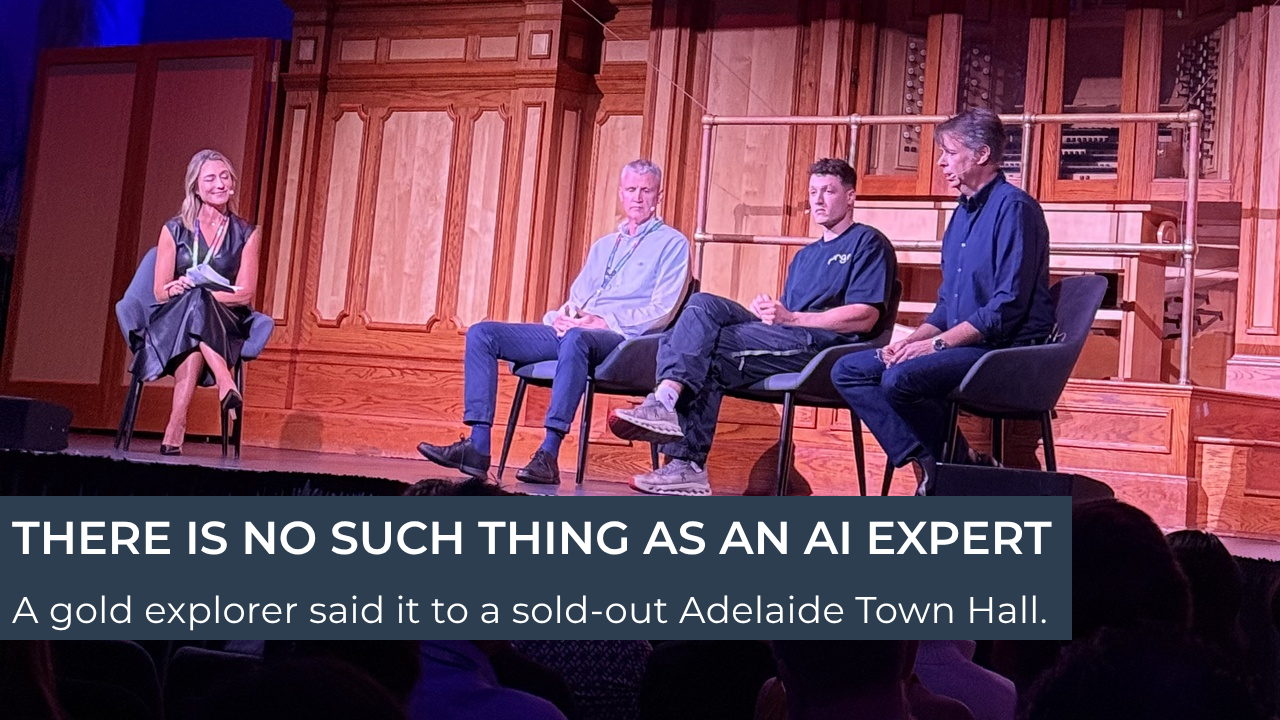
Last week, a gold explorer walked onto the stage at the Adelaide Town Hall and told 1,100 of us there’s no such thing as an AI expert.
If you’re hoping to hire someone to solve all your AI problems, he said, good luck.
It’s a hard line to hear when you do what I do, and I think he’s right. It was also the most useful thing I heard all afternoon, because of what he told us to do instead.
I’ll get to that, I promise. But grab a cuppa and let me tell you this in the order it happened, because he was the last speaker of the day, and most of the people before him had already started making his point for him.
The professor who told us AI won’t kill us, then burned down the Town Hall
The event was Open Summit AI. South Australia’s Minister for AI, Chris Picton, opened the afternoon, and then we got Professor Toby Walsh from UNSW, who’s a good antidote to the hype.
He started by telling us not to worry about the headlines saying AI could kill us. Very reassuring!
Then he showed us a simulation of everyone in that room evacuating in a fire. AI had built it in about a minute, using seating numbers it found for itself. Not many speakers burn down the building you’re sitting in!
He spent much of the rest of his time on what this technology isn’t. It gives you the most probable answer without really understanding what the words mean. It carries our history with it too, so ask an image tool for a CEO and you may well get a sea of white men.
He thinks we’re overestimating how fast AI will change things, because people and organisations are slow to move, and underestimating how far it will go in the long run. Asked if he’s an optimist or a pessimist, he says he’s both.
The part that stayed with me was about truth. When anything can be faked, he said, the price is paid by the people telling the truth, because we may no longer believe them.
If your business runs on trust, let that sink in for a second. Your real client stories and your name on your work could be worth more than ever.
Do me a favour this week: write down one real client story that only you could tell, and ask her if you can share it.
Commissioner Kate Pounder spoke next, from our Royal Commission into AI. It’s the first of its kind in Australia, and it reports by 1 July next year. Then Jack Bear got up and showed us how a business can sit at the top of Google and still not exist as far as AI is concerned.
Your next client won’t type four words
Jack is the founder of Norg AI. On Google, he said, we type about four words: “Best mechanic Sydney CBD.” With AI, the average is closer to 34, and it reads more like a brief. His example gave the car, the kilometres, no dealerships, before Easter, and asked for three options with reasons.
Let’s just imagine your next client doing that. She might not search “business strategist Adelaide” at all. Tonight she might type: “I’ve published two books and taught my method for twelve years. I want someone who can turn it into a business that doesn’t need me in every room. Give me three options with reasons.”
Would AI say your name?
Then he showed us what happened when he asked AI for the best phone plans. None of the big telcos came up, even though they sit at the top of Google. AI had compared the plans on value and reviews, and smaller brands came out ahead.
So what is AI reading? You’ll laugh. Apple has those beautiful marketing pages, plus a plain support site listing every specification, and Jack says AI cites the plain one 18 times more often. “Structure the boring stuff” was his advice.
His team built a plain version of the Be Fit Food website for AI to read, while people still land on the pretty one. (Be Fit Food’s founder, Kate Save, was our MC.) ChatGPT traffic rose 600%, which Jack pointed out is from a small base.
What I loved was how those visitors behaved. They’d already done their research, so they arrived ready to buy.
Jack sees this as the next window, the way early movers did so well out of Google and social media, like Seek and Canva. He sells this for a living, so of course he’d say that. I still think he’s right.
Do me a favour this week: ask ChatGPT, Claude and Gemini what you do, then ask each one to recommend someone for the problem you solve. Note what’s wrong or missing. That’s the start of your boring page: who you help, your method, your books, what it costs to work with you and the questions people ask before they buy, all in plain words.
Then came the panel, and I took two things home from it. One could save you money this week. The other still bothers me.
The $7,000 bill, and the question I can’t put down
Clayton, our gold explorer, was on the panel before his keynote. He said his company puts its purchases through AI, and he credited that with saving millions of dollars a year. He’d recently run a $7,000 bill through it and it found about $500 he’d been overcharged.
That’s a good first job to give AI, because nothing goes out the door. Hold that thought, because I’ll come back to it.
The second thing was a question about jobs. If AI does the entry-level work, how does anyone become an expert? Where do the next experts come from if the first rung of the ladder disappears?
Stanford researchers updated their US payroll study in August. Employment of 22 to 25-year-olds in the most AI-exposed jobs is now 19% below where it would be if it had kept pace with less-exposed peers, and experienced workers show no comparable gap. They’re careful to call these early signs, not proof that AI is the cause.
One explanation they explore is that AI can stand in for knowledge that’s been written down, while it supports the knowledge you only get from years of practice. That second kind is what you’ve spent your life building, and it’s why I wouldn’t hand over your thinking.
In a Wharton-led study, high school maths students using a ChatGPT-style tool scored 48% higher on practice problems. Once it was taken away, they scored 17% lower than students who’d never had it. A version built with guardrails to act as a tutor largely avoided that drop.
Do me a favour this week: before you ask AI about anything important, write down your own answer first. Then compare.
There’s one more person I need to tell you about before we get back to the gold explorer, and he wasn’t even in the room.
The brilliant new hire with all the keys
John McGiffin of Natural Velocity spoke at the Sydney summit in July. That’s the same month I told you I’d given AI the keys to my business, so when I went through his slides, this one got my attention.
Imagine hiring the most brilliant employee you’ve ever met. On day one you hand over your finance system and your customer data, with no training or supervision, and then you go home. John says that’s what a lot of companies are doing with AI agents right now.
His answer is a set of controls, and they work just as well in a one-person business. Your AI should only know what it needs to know. Just because it can reach something doesn’t mean it should. And some actions always need a human, or as his slide put it, “Yeah... let’s not send that email.”
That’s why handing over the keys has worked for me. My newsletter drafts go into Notion for review before my VA schedules anything.
John estimates about half of all businesses are still at the first stage, with people using tools like ChatGPT directly and saving one to three hours a week each. When AI agents take on defined jobs with guardrails, he puts it closer to eight to twelve hours. They’re estimates, but they show why it’s worth moving past the chat window.
Do me a favour this week: give your new hire Clayton’s job. Put your next big invoice or contract through AI on a business account and ask what looks wrong. Before AI goes anywhere near your clients, work through the nine moves in my MIT article. But please don’t put that data into a free Claude or ChatGPT account!
Right, back to the Town Hall. It’s the last talk of the day, and Clayton Cross is walking onto the stage.
So what did the gold explorer tell us to do?
Clayton is the founder of Ellipsis Mining, which uses AI to look for gold in Africa. He sends voice messages from the field to his AI agent, Atlas, which runs on a Mac Mini.
After that line about experts, he explained why: the field is now too wide for anyone to hold. He compared it to medicine. AI is still in the days of the country doctor who attempts everything, while medicine now has cardiologists and neurologists. So be careful of anyone who claims to know all of it.
I’ve been thinking about that one ever since, and it’s pushed me to get much clearer on my own niche. I’ll come back to that.
It’s good news for you as well. “The opportunity is not to know everything,” his slide said. “It is to know your domain deeply.” You’ve spent decades doing exactly that, and nobody with a clever prompt can catch up.
He also warned us how uneven these tools are. They can write excellent code and then fall over reading an analogue clock, which he calls jagged intelligence. So he moves hard questions between models and makes them check each other. I keep two side by side in my own business too.
And then he told us what to do. If you only do one thing in AI, he said, get your data in order.
That was it! I’ve been telling you to extract your gold for a while now, and I didn’t expect to hear it from someone who does it for a living.
He thinks your data will become one of the most valuable things your business owns, and without it you won’t get the answers you’re paying for. It’s what the people making money from this technology had been saying all afternoon. Jack’s boring pages were the same idea.
Atlas draws on a carefully organised Google Drive. Clayton also scores what goes in, giving each document a mark out of ten for relevance and another for accuracy, so the AI knows what to lean on. One of his slides had the line I’d put on the wall: “Messy data turns a powerful model into a confident guesser.”
This is the bit I loved. His experts know the centre of their field better than any machine, and AI is good at noticing what sits outside it. He told a story about AI flagging something at the very edge of a survey that his team wouldn’t have looked at.
Give AI ten years of your session notes and it might do the same for you, spotting the phrase you’ve used with every client and never thought to name. AI surfaces the pattern, as his slide put it, and experts decide whether it matters.
Do me a favour this week: pick the ten pieces of work you’d most want an AI to learn from, like your best chapter or the proposal that always lands. Give each one Clayton’s two marks. Anything that’s out of date stays out.
One line of his has stayed with me more than any other, and it’s why I told you this whole story: “The prompt gets an answer. The context gets the work done.”
What they called context, I call your body of work
For a gold explorer, context is drill results and trench logs. For Be Fit Food, it’s every meal on the menu. Clayton also warned that big businesses start this race ahead of small ones, because something like a bank already has its data organised.
That’s probably true for a bank. If your business runs on what you know, I think it looks different, because your context is your books, your method and how you sound when you tell your stories. Your body of work is your greatest business asset, and for most of us it’s also the most disorganised thing we own.
That’s very good news. You’ve already built the thing they were all talking about. It’s sitting there waiting, probably scattered between your hard drive and your own head!
So here’s where “no AI experts” has taken me. I’m not the automation person. The work I love most is setting up the brain behind a founder’s AI, which holds your body of work and how you’re designed to work, so everything AI does for you starts from there.
I’ve worked with an author who hadn’t thought to give AI her own book. Once AI knows the book and how she’s designed to work, it can do something a generic chatbot can’t. She loves strategy and keynotes, so it tells her to hand over the event logistics instead of helping her do it all herself.
One of Clayton’s slides made the point that the model may change, and the lasting advantage is the context you’ve curated. So I want that brain to sit outside any single tool, somewhere like Notion or Google, where you own it and can take it with you.
It’s the same thinking behind Sassy, my AI strategist, who has always started from how you’re designed to work. Whichever AI you use, the human leads and the system supports.
You don’t need a Mac Mini to start. It’s the same order I teach in Claude by Design: who you are, who you serve and how you write, in three files, before you connect anything. My next sessions are online on 4 November and face-to-face on 16 November, and if you’ve got a team, that’s what AI by Design is for.
So that’s my afternoon at the Town Hall. If your next client wrote that 34-word brief tonight, would AI know you exist? And if it did, would it describe the work you actually do?